Career Tips & Buzz
All Blogs
 I started studying engineering and fell in love with marketing/big data which led me to my current career. One of the things that is so funny is “No matter what you study, it always holds true that you will look for ways to better yourself”; AI will be a tool that will unlock a lot of insight into the future of work. Again, being comfortable with being uncomfortable, and being okay with not being an expert is the best way to be successful in 2023.
Kevin Sardja
I started studying engineering and fell in love with marketing/big data which led me to my current career. One of the things that is so funny is “No matter what you study, it always holds true that you will look for ways to better yourself”; AI will be a tool that will unlock a lot of insight into the future of work. Again, being comfortable with being uncomfortable, and being okay with not being an expert is the best way to be successful in 2023.
Kevin Sardja
13
Sep
What Job Applicants Need to Know About AI in Hiring
September 13, 2022
Learn More >
What Job Applicants Need to Know About AI in Hiring
Artificial intelligence is not just about self-driving cars and Silicon Valley. AI has found its way into nearly every job — and even into landing that job in the first place. Artificially intelligent programs now routinely screen job applications, often before a human hiring manager ever sees a single resume. Companies are also increasingly turning to AI job interviews, a kind of recorded interview that can screen for job knowledge and even analyze body language.
At the end of the day, the same skills that work for the traditional hiring process can be applied to this brave new world. Here are some simple tips on how to sail through the AI systems so you can land your dream job.
Write for the computer — and the human
Employers are increasingly using AI systems to help with screening and sifting through job applications, leaning most heavily on tools known as applicant tracking systems, or ATS. An ATS can automatically compare resumes against the job description and rank candidates based on how well it thinks they fit the qualifications.
That filtering process mostly boils down to how well the software thinks your resume lines up with keywords it notices in the job description or that the hiring manager asked it to search for.
So, how do you spot those key phrases to make an ATS friendly resume?
“The biggest thing is using the job description as a guide,” said Sara Gould, senior assistant director for career engagement at the University of Florida’s Career Connections Center. “Go through it old school with a highlighter, find the language they’re using in their document and then apply that to yours.”
Zero in on required certifications or skills before worrying about “preferred” qualifications. Look for words or phrases that are repeated or meaningful in the industry. See how your background and skills can be shared using this language.
Formatting is also key. If the application specifies what kind of document to submit, follow those directions closely. Typically, a plain Word document or PDF is safe. Fancy graphics or complex columns might confuse the machine reader, so stick to a straightforward layout. Most hiring managers are interested in the substance, rather than the style, of a resume, anyway.
And don’t make the mistake of trying to outsmart the machine. Tricks like posting the entire job description into the resume in invisible white text will get you noticed, but not in a good way. “Those things can be flagged as an anomaly,” Gould said. “It’s a machine learning system, so they’re learning those tricks, too.”
Employers who see these warnings on your application will know you’ve tried to game the system.
But never forget that your goal is to impress the human behind the AI. Avoid robotic lists of keywords. Try to seamlessly weave in the most important qualifications, skills and key phrases into normal language so your own humanity shines through.
Resume keyword scanners also make the personal touch as important as ever.
“Don’t let them stop you from networking, following up, reaching out,” Gould said. “There’s still a person there.”
[/cs_text][/cs_element_layout_column][/cs_element_layout_row][/cs_element_section][cs_element_section _id="6" ][cs_element_layout_row _id="7" ][cs_element_layout_column _id="8" ][cs_text _bp_base="0_2"]AI interviews: dos and don’ts
Also known as recorded interviews, AI interviews are an increasingly common screening tool. They typically ask applicants to record themselves answering timed interview questions. AI interviews may also include skills tests, where applicants have to demonstrate field-specific knowledge or answer questions designed to test for critical thinking. While basic programs might just send recordings to hiring managers, the most sophisticated ones can analyze responses, tone, even facial expressions and eye contact.
“Some companies consider the virtual interview the new resume,” said Ja’Net Glover, director of career services at UF.
As part of the transition to skills-based hiring, these virtual interviews and skills tests can help employers find good fits early in the process.
That may sound intimidating, but preparing for an AI interview is similar to how to prepare for an interview in person or over video with a human.
“Ask the employer you’re interviewing with what to expect during the process,” Glover said. If you learn what software they are using, look up the program’s website and research how it works. You can even use similar tools to practice. Both Google and LinkedIn offer machine-learning-based interview prep.
In addition to doing your research, take the AI interview as seriously as you would any other. Dress appropriately for the job. Find a quiet, well-lit room to record your responses. Imagine you’re speaking with a live interviewer and behave the same way: warm and professional, without a lot of fidgeting.
One advantage in favor of job applicants? They’ll be on their home turf.
“Candidates can control a lot of factors that in a standard interview they wouldn’t have control over,” Glover said. That gives job seekers the chance to practice in the environment they’ll have to perform in. And practice is always the key to a good interview.
“The more they practice, the more it’ll help them feel confident and prepared,” Glover said.
[/cs_text][/cs_element_layout_column][/cs_element_layout_row][/cs_element_section][cs_element_section _id="10" ][cs_element_layout_row _id="11" ][cs_element_layout_column _id="12" ][cs_text _bp_base="0_2"]Resources available
UF’s Career Connections Center helps prepare students for navigating the AI-enabled hiring process through instruction, practice and feedback from career counselors.
Starting in the fall 2022 semester, the career center will also provide access to Quinncia, a new machine-learning-driven interview prep tool that provides tailored feedback on resumes and interviews for AI-driven job searches. Just like resume reviews and practice interviews with human coaches — which will always be a good idea — practicing with the kinds of AI software that UF students will encounter can give them a leg up on the competition.
Career coaches also constantly educate other staff and faculty on campus about the evolving use of technology in the hiring process. And they work with employers to identify trends in AI tools to prepare students for what’s on the horizon.
“This technology will continue to evolve," Glover said. “It’s not going anywhere.”
Eric Hamilton, August 10, 2022
[/cs_text][/cs_element_layout_column][/cs_element_layout_row][/cs_element_section][/cs_content]13
Sep
How to Find the Right Graduate School Program for You
September 13, 2022
Learn More >
How to Find the Right Graduate School Program for You
Want (or need) to go to graduate school but don’t know where to start? Don’t fret! There are a lot of resources and strategies available to help you find your perfect match. You’ll need to do some research about your subject of interest, what degree you want to pursue, and which schools offer what you’re looking for. Once you’ve found 5-10 programs of interest, you can start on the path to your future degree.
What should you study?
There are over 150 graduate fields of study at UF alone, with multiple types of master’s and doctoral degrees. Multiply that by the number of universities in Florida and around the world, and you’ll find that you have a lot of options. With all those choices, it can be hard to decide which programs to consider.
Understand your options
- There are almost as many degree types as there are subjects to study. Luckily, most of these can be broken down into a few categories to help you focus your search.
- Master’s degrees
- These are typically research-based or career-focused, designed for students to enter the workforce after graduation.
- Many master’s programs are designed to teach you all you need, but some can also prepare you to enter a PhD program.
- Most programs take 1-4 years to complete.
- Doctoral degrees:
- The most common type of doctoral degree is the Doctor of Philosophy (PhD).
- Most programs are research-based, allowing you to explore your subject with a faculty advisor.
- Most programs take 4-6 years to complete, depending on your research.
- Professional degrees:
- These are specialized programs for fields that require licensing or other certifications to work.
- Common professional degrees are Doctor of Medicine (MD), Doctor of Pharmacy (PharmD), and Doctor of Dental Medicine (DMD).
- Programs vary widely in the time to completion based on the field.
Work backwards
- If you know what you want to do with your degree, start there! Use resources such as O-Net and other databases to see what education is typically required for your future occupation.
- If your undergraduate degree is in a related field, ask your instructors what they studied and what they would recommend.
- Check out LinkedIn profiles for UF alumni that already have the type of job you want. What did they study?
- Set up informational interviews with people in your desired field to learn about their education.
- Start looking for jobs you would be interested in pursuing. Pay special attention to educational requirements to point you in the right direction.
Where should you study it?
Now that you have narrowed down what you want to study and at what level, it’s time to find specific programs. Some of the research you did on your subject may have given you some options of specific degrees or universities to consider. If not, or if you need more ideas, you have a lot of tools at your fingertips.
Professional organizations
- There are professional organizations for just about every field! They can be great sources of information about educational options, and some have graduate program listings online. Find yours through your Career Community.
- If you will need a license or certification for your field, check with the licensing agency to find approved programs.
Graduate school databases
- There are numerous graduate school sites where you can research and compare programs. Some of the most popular sites are Peterson’s, US News & World Report, and Princeton Review.
Graduate school fairs
- In-person and online fairs are a great way to learn about multiple graduate programs at once and make some connections in the process. Check out our annual Graduation and Professional Schools Fair on October 20, 2022, in the Reitz Grand Ballroom.
How do you get there?
Once you have a group of 5-10 programs you’re interested in, start researching each program and its admissions specifics.
Go straight to the source
- Check out the department or program website for more specific information about the process, including application requirements and deadlines.
- Attend admissions events if the program offers them. You can learn more about the program while meeting faculty, staff, and possible future classmates.
The search for a graduate school program can seem overwhelming, but you can find your perfect match by following these steps. Before you know it, you’ll be well on your way to completing the next step of your education.
[/cs_text][/cs_element_layout_column][/cs_element_layout_row][/cs_element_section][/cs_content]13
Sep
Fraudulent Job Awareness
September 13, 2022
Learn More >
Fraudulent Job Awareness
As you search for internships and jobs, you may come across a posting that seems too good to be true - lucrative salary, flexible location/schedule, transferring money, purchasing gift cards online, vague / low level of responsibilities – we want to make sure candidates know how to identify these fraudulent posts and provide tips for avoiding them altogether.
These red flags are a common theme among fraudulent job listings:
- You received a random, unsolicited email
- The sender asks for personal information such as age, address, phone number, banking information
- The job only says that they need help, but there are no specific tasks or duties articulated
- The poster will only communicate through electronic means, and will not speak on the phone or offer an in-person or video meeting
- The employer does not use a company email address, but communicates using a personal account and typically with poor grammar or spelling without professional etiquette
- They are sending you money without meeting in-person, or they are asking for some sort of fee to apply for the job
- They do not ask you to sign any formal paperwork
- They require that you purchase materials, software, equipment, etc. to begin your role
- The employer indicates that they need a “virtual assistant”
- The salary for the position is much higher than you might anticipate – for example, if they are advertising a high hourly salary to work “whenever you want”
In the event you are contacted with an “opportunity” that features any combination of the elements listed above:
- Do not respond or engage with them in any manner
- Do not click any links present in emails
- Do not deposit any random checks that you receive in the mail without potential verification. Bring your suspicious checks to the bank to deposit, bank tellers are trained to identify fake checks
- Report potential fraudulent @ufl.edu emails to abuse@ufl.edu and notify the Career Connections Center at HireGators@ufsa.ufl.edu to assist
- If you have already lost money, file a police report with the University Police Department or the law enforcement agency where you are located
There are steps you can take to research a company and/or recruiter to confirm the legitimacy of any opportunities presented to you:
- Look at their organization’s website and other job boards such as LinkedIn and Indeed to see if the job they offered you is listed there
- Visit their LinkedIn profiles to confirm that the person contacting you is an actual employee of the organization they are representing
- Contact their human resources department to verify that they are reaching out to candidates to make hires without fielding applications
- If it looks like outreach from a university department, look on the University of Florida jobs portal
- If the position is not listed and someone with an “@ufl.edu” email reaches out advertising a position, look them up on the UF Directory and search the department for their name and call the department to determine if the person works there and is looking for an assistant
12
Sep
Recruitment timeline and what to know before you start applying
September 12, 2022
Learn More >
Recruitment timeline and what to know before you start applying
Campus recruiting timeline overview
Each company will decide on their own timeline based on their practice, talent needs and approach of recruiting. You may see different timeline within the same industry, so please plan ahead and designate sufficient time for your research. Think about it as a project, on average from your application to secure an offer, will take about 6 months. Fall (Aug to Oct) is a popular window of campus recruiting, particular for private sector companies. If you are actively searching for a summer internship next year or graduating in 6 to 12 months, you should take advantage of this career fairs happening at this time.
Strategy Consulting firms: These companies (Bain, McKinsey, BCG, A.T. Kearny) have a very early hiring schedule. The opportunities for next year (both full time and internship) will be posted early summer or even earlier. By middle of summer, companies will wrap up their screening interviews. By Aug, the offers are extended. As it is also very selective, if this is your career aspiration, start your research in the fall, apply as early as possible.
‘Advanced’ hiring: Larger corporations and employers usually adapt this strategy because of the competition of talents as well as they are able to anticipate their needs earlier in the process. They usually release their next year of internship and full-time hiring opportunities towards end of Aug or early Sep. They will start to host info session, attend campus career fairs in Sep. and Oct. Then on a rolling basis, their interview process follows through Oct to next Feb. The first batch of offer may come out right before Thanksgiving, and through out early Spring. Most of their internship starts in late May or early June, usually it will be 10 to 12 weeks. Pay attention to the program detail so you will not miss the application deadline. It is always a good idea to apply earlier.
‘As Needed’ or ‘Just in Time’ hiring: Employers across all sectors – for-profit, non-profit, and government – fall into this category. These employers hire when someone leaves or when the company or organization is growing. When positions become available, employers want to fill the opening quickly. If a position becomes available in February, most employers will not be able to hold it open until June when a graduating student is available to begin working. At UF Career Connections Center, we are hosting different types of career fairs and events to serve the needs, please review our events calendar for more details. It is always a good idea to receive updates from the company’s career page, so you will be alerted with appropriate opportunities come out.
As a lot more companies are using Applicant Tracking System to build up their own talent pool, we do recommend you establishing your talent profile with them and apply the appropriate opportunities as it comes. If there is no specific application deadline highlighted, it usually will be closed as it is filled.
[/cs_text][/cs_element_layout_column][/cs_element_layout_row][/cs_element_section][cs_element_section _id="6" ][cs_element_layout_row _id="7" ][cs_element_layout_column _id="8" ][cs_text _bp_base="4_4"]Typical campus hiring process/steps overview
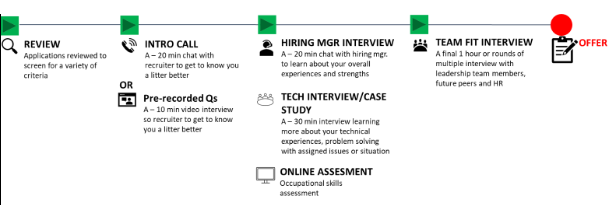
We have summarized the common 5 stages of hiring process and illustrated as above graphic. Usually, it is Review, Intro Call, Hiring manager interview , Team fit interview and Offer. Based on the job nature and company practices, there are additional interview steps may be added. For example, a lot of tech companies will add Tech Interview, consulting firms usually will add case study, some FMCG companies would add occupational online assessment after the Intro call. Understand the expected process/steps will help you prepare ahead. The whole interview process may take 2 weeks up to 4 weeks. Since COVID, we do see a lot more companies start to use pre-recorded Qs for the initial interview. UF C3 has included Quinncia as a resource for students to get familiar and practice for the interview. Please check on UF C3 website for more details.
[/cs_text][/cs_element_layout_column][/cs_element_layout_row][/cs_element_section][cs_element_section _id="10" ][cs_element_layout_row _id="11" ][cs_element_layout_column _id="12" ][cs_text _bp_base="4_4"]What should I do before I start to apply?
- Understand the campus recruit timeline and hiring process.
- Get your resume and other application documents ready.
- Establish and polish your LinkedIn profile.
- Prepare a job search tracking spreadsheet.
- Schedule an appointment with Career pathway coaches at UF C3 to review your strategy and get more information related to your career interests.
- Narrow down your industry, companies, and even job titles.
What are the good job boards I should use?
- Gator CareerLink (dedicated to UF students)
- LinkedIn (more than just a job board)
- Company career website
- Professional association career website if applicable (please check on UF Career Pathway website for more details)
- Indeed (for broader internship opportunities, recommend applying from company career website)
Should I attend the career showcase/career fairs if I can just apply online?
The answer is YES. We even encourage you to apply prior to Showcase if it is applicable. Career Showcase itself is a great opportunity to network and connect with industry. It is also a great opportunity to hone in on your self-presence in a professional environment and how to engage in a meaningful conversation that will benefit both parties. Make sure to bring your resume, stories to share, questions to ask and bring back the better knowing of expectations, opportunities, and industrial contacts.
[/cs_text][/cs_element_layout_column][/cs_element_layout_row][/cs_element_section][cs_element_section _id="22" ][cs_element_layout_row _id="23" ][cs_element_layout_column _id="24" ][cs_text _bp_base="4_4"]I am a master’s degree student, is there any difference of my job search process?
Whether you are in a 1-year or 2-year master’s program, your professional success is best guaranteed through proper preparation and anticipation of the process that lies ahead. While this can be seen as a challenge, you should know that the Career Connections Center is here to help you every step of the way. Before you arrive UF campus, feel free to check out our online resources and coming events at www.career.ufl.edu. Because the Fall is a big hiring window, we would encourage you to engage earlier and know your academic requirement before you start to apply for internships. Sep. and Oct. can be hectic time as you are get acquainted with UF campus, adjust to your academic schedule. That is why UF C3 intentionally host several workshops to help you to identify your strength/skills, communication with employment opportunities, resume labs etc. You can also take advantage of our express drop-in and individual appointment services to get yourself prepared. Even if you miss the Fall career showcase, it will come back in the Spring (usually early Feb), your ability to engage with employers, discover new interests, and pursue opportunities will be possible year-round!
[/cs_text][/cs_element_layout_column][/cs_element_layout_row][/cs_element_section][cs_element_section _id="26" ][cs_element_layout_row _id="27" ][cs_element_layout_column _id="28" ][cs_text _bp_base="4_4"]Can I apply for multiple roles with the same organization?
Yes, you absolutely can. Pay attention to specific rules if any the organization set up. For example, if you failed in one position interview, you may not be allowed to apply again in 6 months. Also bring good questions in any interaction with the organization and reflect on your learnings along the journey so you can find the right fit.
[/cs_text][/cs_element_layout_column][/cs_element_layout_row][/cs_element_section][cs_element_section _id="30" ][cs_element_layout_row _id="31" ][cs_element_layout_column _id="32" ][cs_text _bp_base="4_4"]
Who should I put down as references on a job application?
References should be provided to employer as a separate document, DON’T include them in your resume.
Generally speaking, your future employer wants to talk with the following people for a professional reference, in order of importance.
- Your current manager or supervisors (part time job, on campus job, research assistant, teaching assistant, peer advisor, mentor, internship, volunteer services)
- Your previous managers or supervisors (part time job, on campus job, research assistant, teaching assistant, peer advisor, mentor, internship, volunteer services)
- Your faculty who can speak to your experiences and knowing of your strengths and professional development
- Your personal reference or friend who will vouch for you (Do not use your parents, unless they have been supervising your professional work.)
Should I prepare a cover letter for the application?
Cover letters enrich your application as you are sharing who you are and who you want to be, which is different from your resume: what you have done in the past. If you are really interested in a particular position, have a tailored cover letter even if it is a supplementary document per guidelines. If the job application has a clear instruction to not include a cover letter, then follow the instruction so as not to annoy your potential employer. Here is the C3’s guide for how to compose a cover letter.
[/cs_text][/cs_element_layout_column][/cs_element_layout_row][/cs_element_section][cs_element_section _id="38" ][cs_element_layout_row _id="39" ][cs_element_layout_column _id="40" ][cs_text _bp_base="4_4"]What is the difference between full time and contract employment?
Contracted workers are not “employees” since they provide services on a short-term or individual project basis. You are either self-employed or employed by a third-party company. Contract workers do not have to be offered the full package of benefits that full-time employees will have access to, for example, taxes, pension/retirement, and healthcare. The full burden of these items is the responsibility of the contractor.
[/cs_text][/cs_element_layout_column][/cs_element_layout_row][/cs_element_section][cs_element_section _id="42" ][cs_element_layout_row _id="43" ][cs_element_layout_column _id="44" ][cs_text _bp_base="4_4"]What is ATS?
An applicant tracking system is a software application that enables the electronic handling of recruitment and hiring needs. The principal function of an ATS is to provide a central location and database for a company’s recruitment efforts. Recent changes include the use of artificial intelligence (AI) tools to facilitate guided semantic screening of applicants. In many cases they can filter applications automatically based on given criteria such as keywords, skills, years of experience and others. That is why optimizing your resume for ATS is important. If you miss the key words and critical criteria listed in the job description, your chances of landing an interview call may be decreased.
[/cs_text][/cs_element_layout_column][/cs_element_layout_row][/cs_element_section][cs_element_section _id="46" ][cs_element_layout_row _id="47" ][cs_element_layout_column _id="48" ][cs_text _bp_base="4_4"]What is an AI interview?
As the average resume generated for any one job posting is above 250, more companies are using AI programs to do an initial screen. The process requires the candidate to video record answers to pre-recorded questions. Yes, you are looking at yourself on the screen and answering 3 to 5 interview questions. Then, a guided algorithm will shortlist the ideal candidate before the recruiter and hiring manager review the recordings to select a candidate for the next interview round. If you have such an arrangement expected, please reach out to UF C3 for tips and advice. In short, treat it as an in-person interview. It is easy to say though, practice will help. Check on the Mock Interview Module available in Gator CareerLink.
[/cs_text][/cs_element_layout_column][/cs_element_layout_row][/cs_element_section][cs_element_section _id="50" ][cs_element_layout_row _id="51" ][cs_element_layout_column _id="52" ][cs_text _bp_base="4_4"]What is E-Verify?
E-Verify is a web-based system that allows enrolled employers to confirm the eligibility of their employees to work in the United States. It is not a criminal background check. Your employer will usually include the instructions and information needed in the onboarding communication and preparation.
[/cs_text][/cs_element_layout_column][/cs_element_layout_row][/cs_element_section][/cs_content]12
Sep
How to find an on-campus job
September 12, 2022
Learn More >
How to find an on-campus job
Why should you work on-campus?
When you are working for a UF department you are a student first! A normal workweek is 10 to 20 hours, and 20 hours per week is the maximum students may work on campus. Almost UF department offers part-time job opportunities for student.
Not only do on-campus jobs put you first as a student, and make your commute from class easy, they also offer you an opportunity to gain the top skills employers are looking for in their new hires.
According to the UF Graduation Survey, students who work during their time at UF are more likely to have obtain employment at the time of employment compared to those students who do not work!
[/cs_text][cs_text _bp_base="0_2"]How do you find an on-campus job?
Now that we have sold you on the benefit of working on-campus, I know you are thinking “how do I find an on-campus job?” This is the best part, all UF Departments post their open student positions through Careers at UF. Once one the Careers at UF’s website use the “Refine Search” toolbar on the right hand side to filter the jobs to just show you “student assistant” opening:
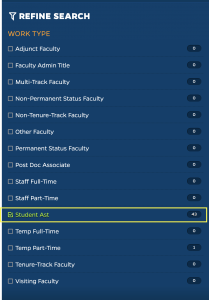
One you have used this filter tool the list of open student positions will populate on the left hand side of site. On this list you will see both Federal Work Study (FWS) and Non-Federal Work Study positions. In order to apply for a FWS position you must have this as part of your financial aid packet, as these positions are federally funded and need-based. To learn more about the Federal Work Study program and how you can qualify visit the Office of Student Financial Aid and Scholarships.
Once you find a position that is of interest to you, clink the title of the role to learn more about what this role entails, requirements for applicants, the salary, and when you will need to apply by. When you are ready to apply with a resume and cover letter , click the “apply now” button on the right hand side to start the application process.
[/cs_text][cs_text _bp_base="0_2"]Wish you talk to the hiring departments in person before your apply?
Well, you are in luck! The UF Career Connections Center hosts a Part-Time Job Fair every Fall semester in the Reitz Union North Lawn Terrace, and many on-campus hiring departments attend this fair looking to hire student positions.
[/cs_text][cs_text _bp_base="0_2"]Need help preparing?
If you need assistance in creating your resume, cover letter or what to expect at the Part-Time Job Fair, stop by the Career Connections Center during our Express Drop-in hours and one of our staff members will help you prepare your material.
[/cs_text][/cs_element_layout_column][/cs_element_layout_row][/cs_element_section][/cs_content]12
May
The Success Formula
May 12, 2021
Learn More >
The Success Formula
- What are you passionate about?
- What are your long-term goals?
- What have you already done to start working toward those goals?
25
Mar
Q&A with Ninoska Peterson
March 25, 2021
Learn More >
Q&A with Ninoska Peterson
Ninoska Peterson
The Gator Career Consultant Q&A Series aims to create a diverse collection of career experiences through highlighting University of Florida (UF) alumni. Ninoska Peterson graduated from UF with a doctoral degree in clinical psychology. She is a health psychologist in the Department of General Surgery at the Cleveland Clinic in Ohio. In her role, she evaluates patients seeking bariatric surgery, prepares them before surgery, and sees them after if they have adjustment issues. The UF Career Connections Center spoke with Peterson on her experiences at the university and her career journey as a clinical psychologist.[/cs_text][cs_text]Can you share your experiences with involvement at UF? During my time as an undergraduate, I was involved in a couple of different research labs for the Department of Psychology and in the College of Liberal Arts and Sciences. I also worked in a research lab in the College of Health and Human Performance, and that was more of an exercise psychology lab. Hence, my transition from psychology to exercise. It was actually fun. I also did some volunteer work with Shands Hospital. I remember it was playing with kids in the waiting room,probably for pediatrics. And then, when I started my Ph.D., we actually worked with a lot of undergraduate students in our lab. At that time, I was a peer mentor. In my master's, we also got to teach different sport and exercise classes for undergrads. What did you learn about yourself from those experiences? I liked the interaction with people, whether it is patients that we were working with or in the context of teaching, research or mentoring. I wasn't the person that just wanted to sit in front of the computer and do data entry and write. That was a piece that I enjoyed, but I actually liked the interactions. How did you learn about the different opportunities? In our undergraduate classes in psychology, it was something that was mentioned. Also, I think that was a part of the UF career center where you could also look up the different opportunities that you can do, whether it was work-study or an opportunity to volunteer to get the kind of experience under your belt that you don't just get from sitting in a class and reading a book. How did you develop professionally from those experiences? The networking piece is something I really liked. It gave me a chance to meet graduate students when I was an undergrad working in the lab. It was reaching out to people that happened to take me under their wing and talked to me about, "Hey, here are some other opportunities that maybe you haven't heard about." Especially in psychology, people don't even know all the different things you can do. I didn't really know about health psychology and all the different aspects of that. Working in different labs helped me learn about that. I worked in the exercise science lab in Health and Human Performance, which I ended up doing my master's in. I didn't even know that was a thing. It was just meeting different people and then being able to go to conferences and present posters to meet more people and get different opportunities with that. Is there something that you know now about your career path that you wish you knew while you were a student? It's not a straight line. I think we always come in with our goals. Thinking, “This is what I want to accomplish.” People kind of tell you that. I finished my undergraduate degree in four years, and when I started, I thought I was going to go to medical school, and that didn't happen. I always stuck with psychology, but I did veer off into exercise science, and I'm kind of going back to psychology. But everything I've done really helped me with my career today. So I can look back and say it wasn't necessarily a waste of time, even though it wasn't straight line doing a bachelor's, doing a master's, and doing a Ph.D. It kind of went off a little bit, and it came back to where it was supposed to be. What is one thing that you have accomplished in your career that you're really proud of? I'm doing what I set out to do. I'm working at the number two hospital in the nation, which is amazing. I never thought I would see myself in Ohio. I'm from South Florida, and I lived in Gainesville for a really long time with all my degrees. I moved to Virginia, and now, all of a sudden I'm in Ohio. Never say never, and stay open. What are two things that you would tell current students to do now to prepare for their future careers? Reach out, ask questions and talk to people. I met with professors. I talked to graduate students and people who were in the field. So ask questions, and be curious. And again, be open to new experiences. It may just teach you what you don't want to do, which I think is just as important as learning what you want to do and what you enjoy. Want to share your experience with other Gators? The Career Connections Center is recruiting Gator Career Consultants.[/cs_text][/cs_column][/cs_row][/cs_section][/cs_content]25
Mar
Q&A with Patrick O’Keefe
March 25, 2021
Learn More >
Q&A with Patrick O’Keefe
Patrick O'Keefe
The Gator Career Consultant Q&A Series aims to create a diverse collection of career experiences through highlighting University of Florida (UF) alumni. Patrick O’Keefe graduated from UF in 2014 with a master’s degree in mass communication and is currently an adjunct lecturer for the political communications master’s degree program at UF. He is currently the director of customer success at Anedot, a financial technology company that helps nonprofit organizations collect donations. O’Keefe is responsible for managing the Success team to help Anedot customers get the most out of their efforts to drive fundraising and engagement. The UF Career Connections Center spoke with O’Keefe on his experiences at the university and his career journey as a director of customer success.[/cs_text][x_image type="none" src="https://career.ufl.edu/wp-content/uploads/2021/03/Patrick-OKeefe-Headshot.jpg" alt="Patrick O'Keefe Headshot" link="false" href="#" title="" target="" info="none" info_place="top" info_trigger="hover" info_content=""][cs_text]How did you balance your full-time job and your time as a graduate student? It varied depending on the semester. I think when you first get started, it's very challenging. The university provided a lot of resources, and I was able to come through it. And then after that, I felt really good about it. Towards the end, it became a struggle again, but that was mostly because I was working a lot. If you have a 9-to-5 workday I think it works pretty well. If you're working 80 hours a week, then it becomes a little more challenging. I did a lot of coursework on the weekends and in the evenings. I think it was a huge leg up to be able to do that because if I had to take time off and not be able to have that full-time working experience, it would've hurt my career. It would have also hurt in terms of income. I was able to not take out as many loans because I was working full time, and I was able to pay off a lot of the degree. It was really huge for me being able to do the degree the way the university positioned it because I have firsthand knowledge from the person who hired me that I got a promotion because I was doing the degree. I got to move from sales into more of a consulting role because of that. It was a huge jump for my career both in terms of advancement and in terms of salary. What were you involved in as a student? I did my undergraduate at Florida International University, and I was very involved. I was in Student Government, I was Student Body President when I was there and I was involved in a fraternity. I always encourage everybody to get involved because I think that was a huge learning experience for me, just in terms of maturity and meeting people. A lot of the people I'm still friends with to this day. There's a lot of advantages to that. Now I'm in Daytona, I think the cool thing about UF was that I felt a strong connection despite being online and not being on campus. Beach and I'm looking at the local Gator club here, which I really didn't know a lot about until recently when other alumni mentioned it. It's been helpful to be able to connect in that way. What advice do you have to students who are not on campus and might have to build connections virtually? The key is to take advantage of the resources you have and really put yourself out there. There are usually Facebook groups for the colleges and there are alumni groups local to your area. Take advantage of all those big names on LinkedIn. If you do meet an alum, see who their second connections are. See who went to UF and lives in the area and reach out to them. I think a lot of what you need to do is make yourself valuable in a lot of ways. If you reach out to somebody and say, "Hey, I really respect you. I'd love to get to know you because I like the path you've taken. Is there an opportunity to volunteer with you, or is there somebody else I should meet?" Most people are not going to say no. Most people are at least going to have the courtesy to say, "Hey, I'll take a call. Hey, I'll meet with you. Hey, talk to this person." When I think of networking, I think of, "How am I going to reach out to people that I respect? How can I get them to help me? How can I be useful to them potentially?" I think most people think that it needs to be like a formal internship, which can be really hard with COVID, where a lot of companies don't have these formal paid internships. But if you reach out to them and say, "Hey, can I volunteer with you five hours a week?" I think most people would be fine with that and let you shadow them. Did you always know you wanted to hold the job you have at the moment? Not exactly. It's kind of been a meandering path. I always had an interest in politics. I really thought I wanted to work on Capitol Hill, and then I went to D.C., did an internship on Capitol Hill, and really didn't like it. I went into business and found I actually didn't love sales, but I was fairly good at it. Then I moved into marketing. I did digital marketing a lot. I sort of used my interest in politics and my interest in digital marketing and brought them together. I definitely didn't always know. I tried a bunch of things out. I found a couple of things I liked, and then I found the cross-section between a couple of the things I liked. What are two things that you would tell students to do now to prepare for their future? It's all networking. When you're in college, get involved, whether that be in student government, a fraternity, a sorority or a club. Whatever that is you're passionate about. Also, connect to your professors. I found some of my professors had amazing networks. Especially in the political field. Even though they may not have done it, they had friends who were consultants or people that connected with them, and they did things on an academic level. They worked with the people who were doing on the practice level when they were writing the report. I think building those connections and really exposing yourself to a bunch of different types of opportunities is really important. Talk to people who are more senior level, who have the jobs that you think you want one day. Talk to them about their paths because everyone has a different path, but they can give you some good steps. I think the other piece of advice I would give is don't lose hope. A lot of people come out of college, and they can't get an entry-level job in the field they want. They think they are not cut out for this. Go get the job you can get and go spend five or 10 hours a week volunteering with the company or organization that you're really interested in. If you don't have the experience now, look at the job description and say, "What do I need to do to get that experience?" Even if it's not paid. With today's technology, you can go and Google anything and learn how to do nearly everything. Use LinkedIn and use Google to their full potential because if you hustle, you really can make it in any field. Want to share your experience with other Gators? The Career Connections Center is recruiting Gator Career Consultants.[/cs_text][/cs_column][/cs_row][/cs_section][/cs_content]23
Mar
Q&A with Elena Pastore
March 23, 2021
Learn More >
Q&A with Elena Pastore
Elena Pastore
The Gator Career Consultant Q&A Series aims to create a diverse collection of career experiences through highlighting University of Florida (UF) alumni. Elena Pastore graduated from UF in 2019 with a bachelor’s degree in business administration and a master’s degree in international business. In addition to being a freelance consultant, she runs her own career coaching business that helps develop and train college student leaders, especially in Greek-letter organizations, to enhance their leadership skills. Pastore’s programming includes career coaching and consulting services for people of all ages, industries, and experience levels and enables clients to be impactful and influential in their roles. The UF Career Connections Center spoke with Pastore about her experiences at the university and her journey as a leadership and career coach.[/cs_text][x_image type="none" src="https://career.ufl.edu/wp-content/uploads/2021/03/Elena-Pastore-Headshot-scaled.jpg" alt="Elena Pastore Headshot" link="false" href="#" title="" target="" info="none" info_place="top" info_trigger="hover" info_content=""][cs_text]Can you share your experience with involvement in UF? My involvement pretty much spanned Greek life and business school. Those were the two major groups that I was involved in. I really loved being a business major. We gained a lot of great insights in class, but then the learning really comes with the application of the principles and the things that you learn. There was one specific program that I was involved in for my whole duration of college, which was called the Leadership Development Program. I was a mentee my freshman year, then I became a mentor and then I had a few director roles. Eventually, I became president for my senior year. One of the things that really meant the most to me in pouring my time into that organization was creating the optimal experience for the mentees—making sure that they were getting a lot out of their participation, engaging with the group and the other mentors and mentees, and setting up the organization with a strong culture where everyone feels comfortable sharing, participating and feeling that sense of value and belonging within the organization. How did you come to create your own company? I had those leadership positions in college, and I've always liked helping develop other people. I’ve always loved teaching them how to be successful for the job and internship search and how to be a good leader when they embark on that next step. I wanted to find a job as a leadership coach or some type of people development coach where, regardless of whether it was a career- or leadership-related, I would be able to help them develop their interpersonal skills. That's what I wanted to do, but I couldn't find a company that hires a fresh graduate for that. I said, "I'm confident that I can get my own business if I start a company doing this, and I think there's an opportunity that I can take advantage of." I had the vision to start my company doing leadership coaching for students in Greek life organizations by training, coaching, and working with the executive boards. I had that specific idea because that's a group that I know. I had similar leadership positions, so I can relate to them. I've learned a lot from my business experience to where I feel like I can help them be really effective leaders and sort of walk them through things that I learned to prevent from making mistakes and being any less effective than they potentially could be. I'm very qualified to do that. It's just that there's no company that already does that. I really feel like there's always a way to do something you love, and you don't have to feel like, "I can't do something I love now. I have to wait five years." I would have probably enjoyed a lot of other jobs out there, but I didn't want to wait to do what I love because someone couldn't hire me to do it when I could hire myself to do it. What is one thing that you would tell students to do now to prepare for their future? Even when you don't know what you're going to be doing in a few years, you're always selling yourself. You don't know who might be able to hire you for a job or what person might be able to introduce you to someone that can hire you for a job. You don't have to have the end in mind, and you don't have to have the outcome picked out today, but you need to be meeting people, making connections, and treating everyone kindly. You need to be putting yourself out there, learning from people and learning about different things and different topics. All of those things can be connected in some way down the road that will make a transformational impact on your life and what you're trying to do. A lot of times, that's very hard for students to understand because it's very intangible. It's very hard to see or to picture how an ambiguous or seemingly insignificant situation could help me or how it could help you. Many connections I've made over the last few years have already paid off in the most unpredictable ways, and I'm still not even that far out of college. I think students really underestimate the power of networking and building those connections early on because it really does serve you well when you put the effort in. Want to share your experience with other Gators? The Career Connections Center is recruiting Gator Career Consultants.[/cs_text][/cs_column][/cs_row][/cs_section][/cs_content]23
Mar
Q&A with Victoria Steele
March 23, 2021
Learn More >
Q&A with Victoria Steele
Victoria Steele
The Gator Career Consultant Q&A Series aims to create a diverse collection of career experiences through highlighting University of Florida (UF) alumni. Victoria Steele graduated from UF in 2012 with a bachelor’s degree in electrical engineering. She is currently a principal software engineer at General Electric Appliances, where she develops firmware for induction cooking and motor control inverters. Steele also earned a master’s degree in electrical engineering from the University of Louisville in Kentucky. The UF Career Connections Center spoke with Steele on her experiences at the university and her career journey as an electrical engineer.[/cs_text][cs_text]Did you ever use the C3 or attend Career Showcase during your time at UF? I went to the career resource center quite a bit. I used their resume and interview prep services and went to almost every career fair starting my freshman year. I obtained my job with GE Appliances by attending a career fair. How did you feel about attending Career Showcase your first year? My freshman year, I went right in the fall semester when I got there, and I kind of wandered around like a deer in the headlights. It was really overwhelming, but then, by my last semester, it was honestly really fun and invigorating. When I was actually seriously looking for a job, I already had some co-op experience because of the CRC, which was really cool. By then it was really fun talking to recruiters, getting dressed up, and having your resume game plan ready. It was awesome. Did you get your co-op through Career Showcase? I actually did seven internships. I started out in the Department of Transportation for Lee County, which I got through a connection through my high school. Based on this experience, I decided that civil engineering was not for me, and I switched to electrical engineering. I interviewed with GE appliances through the CRC my sophomore year. I joined GE Appliances full-time in 2013, so my job now is definitely because of Career Showcase. Can you share the skills you developed through your involvement in student organizations? I was involved with SWE (Society of Women Engineers) primarily and a little bit with Women in Electrical and Computer Engineering (WECE). For SWE, I actually chaired one of their organizational events for incoming freshmen. The event is called eSwamp. When all the incoming freshmen engineering girls came in over the summer, we would organize a day down at Lake Wauburg where they would do canoe races and all sorts of other icebreaker activities. Honestly, I think that experience has made me really interested in bringing more women into STEM, which is one of my personal goals. It also helped me understand how to interact with new people that are coming into our organization, how they might be nervous or uncomfortable, or what their fears are. It was really a great opportunity to just be involved with an upcoming generation of new engineers. What advice do you give to women in STEM? I absolutely love my job. I love my career. There are so many opportunities for you as an individual to grow. I think being in a STEM field really means being independent and courageous, and it's really empowering to be a woman in this field. Do you ever suffer from imposter syndrome? I work in a field called power electronics, which is part research and development and part product development. When I'm in the office, I sit between two PhDs guys that have over 20 years of experience. One of them has been writing code since I was born. Every day, I'm hanging on by the skin of my teeth, but I think what's important to remember is that I have skills that they don't. I bring something to the team that they can't bring. I am the only woman on the team. I've been the only woman on the team for five years now. That in itself is a position of power. Is there anything that you know right now about your career path that you wish you knew while you were in UF? I think one of the things that I really wish I hadn't focused so much on when I was a student is being absolutely perfect and knowing the right answer all the time. I absolutely had to have a perfect grade. When you go to the workplace, you realize that you are not going to know the answer all the time, but you were equipped to find the answer, and it is okay to make a mistake. What career accomplishments are you proudest of? When I joined the group that I am on, it was really kind of a disparate group of individuals. Everyone worked in their own silo. Everyone wrote code in their own silo. Nobody really communicated. Since I have joined the team, one of the things that I have worked really hard to do is to make us more cohesive and interactive. From a software development perspective, to bring up the current coding standards and make sure that we're really operating as a unit instead of 10 different individuals. I personally feel that I have worked and contributed to making that happen. And I'm proud of that. Is there anything else you would like to share? Be bold. If you're thinking about going to the Career Showcase, do it. The earlier you get out there and start exploring options, the earlier you figure out the right path for you. Interning, co-oping and working part-time are all really important experiences to help you develop as a professional. Those experiences make sure that not only are you finding a job, but you're finding your calling. Want to share your experience with other Gators? The Career Connections Center is recruiting Gator Career Consultants. [/cs_text][/cs_column][/cs_row][/cs_section][/cs_content]22
Mar
Q&A with Ryan Chase
March 22, 2021
Learn More >
Q&A with Ryan Chase
Ryan Chase
The Gator Career Consultant Q&A Series aims to create a diverse collection of career experiences through highlighting University of Florida (UF) alumni. Ryan Chase graduated from UF in 2007 with a master’s degree in education. He is currently a middle school principal with Sarasota County Schools and has been in education for 14 years. The UF Career Connections Center spoke with Chase about his experiences at the university and his career journey in education. [/cs_text][x_image type="none" src="https://career.ufl.edu/wp-content/uploads/2021/03/Ryan-Chase-1.jpg" alt="Ryan Chase's headshot" link="false" href="#" title="" target="" info="none" info_place="top" info_trigger="hover" info_content=""][cs_text]While you were at UF, did you ever utilize the career center? I did. Back then, they had some resume workshops, and I did some work with them. Then, through the UF education department, they would do career fairs in collaboration with the university’s career center; it’s actually how I got my first teaching job! As an administrator in my county, I have participated in UF career fairs to represent Sarasota County and try to hire Gators. I found it to be a great resource. I've hired probably a hundred people over the last 10 years, and workshops like these can help recruit some of the best talent coming out of college programs. Can you share your experiences with involvement at UF? I worked at the front desk of the Reitz Union Hotel, which was a fun experience. What's funny is when I got there, I didn't even know there was a hotel. I ended up interviewing because I met somebody in a class who worked there, and I got an interview, and it was just important to stay connected. I thought it was nice to work on campus because I got a good feel for what was going on. That was when we won a bunch of basketball and football championships, so I got to meet a bunch of the guys that would walk by. It was kind of fun. Then, when I was in graduate school, I ended up playing some intramural sports, and I thought that was such a good way to connect with people, too. We played softball and kickball, and I found that to be a nice way to stay connected to the campus because we were all so busy and we were also tired and stressed, but we would go out, we'd have fun and we’d connect in a different way. I find that that's like how we do business at the school I work at. As a principal, I connect with not only teachers and students in my building, but also when I see them outside of work, or I go to a student's basketball game. It's like that extra connection is what really drives home that relationship. That's really been an important part of how we can stay successful as educators, too. Did you have experience with job shadowing or practicum opportunities? As part of my degree, I had to teach in multiple locations. I did a practicum teaching experience at Kanapaha Middle School. I taught social studies there. That was a great experience. Then I did my internship teaching at Buchholz High School. Luckily, I got to go around to a bunch of different schools in the area and participate in those experiences. Those are the experiences that I remember because going into a classroom the very first time as a teacher, you draw on those experiences, and you remember what you've done. Having an internship or practicum experience provided me the confidence to say, "I know how to do this" or "I know who to ask when I am struggling." The group of people I taught with in those experiences was amazing. I still have relationships with a lot of them and I still talk to some of the professors and email with them. There are resources that are on my bookshelf from when I was a student 15 years ago, and I still look at them every year when I start the school year or am seeking assistance.[/cs_text][cs_text]What did you learn about yourself from those experiences? I'm a first-generation college student, and literally, no one in my family had ever been to college. No one had even thought about it and some members of my family barely graduated from high school. My dad got his GED, and my mom graduated with my brother in attendance. It wasn't a given. My brother finished high school but went to the Navy. When I graduated from high school, I knew I would go to college, but I didn't really know where to go, so I did two years at home, and then I transferred to UF. I felt like I was taking a chance. I was investing in myself for the first time. I was moving away from home for the very first time, and I was experiencing new things that I never knew. I think what I learned about myself through that is that I was far better than I ever gave myself credit for. I was far smarter than I would have given myself credit for. I had more skills than I would have believed in myself. I had the ability to be more confident. A kid like me who grew up in a small town in Connecticut, who came from almost nothing, moved to South Florida, knew no one, and went on to graduate with two degrees from UF, a third degree from another university, and is a principal by age 35. It's something that I'm very proud of. Just last week, I was elected the president of the Sarasota County Gator Club, the alumni association here in my area. Now I get to give back, and I get to be a part of this university that did so much for me and that really opened a lot of doors. Everything opened when I started believing in myself, and those experiences did a lot for me. What are two things you would tell current students to do now to prepare for their future careers? Get involved. Find something you're passionate about and find a way to get involved in it. Whether that's working with student government, starting an organization, working on campus, or volunteering. This has been vitally important throughout my career. I worked three years as an assistant principal at the high school level, and kids who were involved in the high school were so much more successful. What I find to be really kind of powerful is to find people that you can connect with on some level; it doesn't have to be academic. You could just start a bowling club, and that's it. It's people that you're interested in. When working with students, we talk about developing four key competencies: critical thinking, communication, sense of self, and teamwork. Would you be able to give me an example of how employing one of these competencies or all has helped you in your career? I have hired quite a few people: teachers, district staff, paraprofessionals, teachers' aides, registrars, secretaries, and anybody you can think of. One day I'll get to hire an assistant principal. I would say all of these things are important to me. When I look at a resume, I feel like I can see these things. When I ask questions, I can hear these things. These are definitely areas that I'm looking for. When I ask a question, sometimes it's not what I'm asking or what you're saying; it's how you're saying it. It's how you carry your response that I think is very important to me. Teamwork is critical to what we do. It's actually so important to us that our teachers teach on teams. As a school, teamwork is so important. I can't teach all those classes. I have to rely on our team of people to get the work done. I've got a team of assistant principals. We've got a team of support staff. I've got a team of teachers. And if we're not all working through the same shared vision, which is my responsibility, then we are not going to get our job done, which is to create a safe and effective learning environment for students. And that's our responsibility. That's what we get paid for. Every single one of those things is extremely important. Without a doubt, these are things that we can see in interviews and read on resumes. They are definitely part of our decision-making and interview process. Want to share your experience with other Gators? The Career Connections Center is recruiting Gator Career Consultants.[/cs_text][/cs_column][/cs_row][/cs_section][/cs_content]11
Jan
New Year, New You? Set Career Goals That You Can Achieve
January 11, 2021
Learn More >
New Year, New You? Set Career Goals That You Can Achieve
20
Oct
Five Tips for Getting Your Foot in the Undergraduate Research Door
October 20, 2020
Learn More >
Five Tips for Getting Your Foot in the Undergraduate Research Door
25
Sep
5 Transferrable Skills from Studying Abroad
September 25, 2020
Learn More >
5 Transferrable Skills from Studying Abroad
4
May
3 Ways to Utilize your Top 5 Strengths in the Job Search
May 4, 2020
Learn More >
3 Ways to Utilize your Top 5 Strengths in the Job Search
- What do my strengths say about me?
- How are my strengths connected, if at all?
- What kind of work/job environment would further these strengths?
4
May
So, Your Summer Plans Have Changed. Now What?
May 4, 2020
Learn More >
So, Your Summer Plans Have Changed. Now What?
- Manage your expectations for this time. Your definition of productivity or success may shift, and that is totally okay. Your worth is not determined by what you have done or what you will do in the future. You are worthy right now, as you are.
- If you are finding yourself with more unstructured time, consider re-evaluating your priorities and setting some new goals, intentions, and routines for the next several months. This shift in daily life may help to clarify which things you really enjoy and are engaged by the most and what you can let go of. Use some of our self-guided assessments and activities to reflect on your career interests, values, strengths, and skills.
- While you may no longer be able to physically study abroad, you can still find ways to gain global experience. You can enroll in the UF International Scholars Program to structure global experiences through international coursework, language learning, and co-curricular activities. Additionally, programs like CEA are offering virtual internships abroad and apps like Duolingo allow you to learn a new language from home.
- If you are still looking for a summer internship or full-time job, there are options available through virtual internships or freelance and remote work. Follow up with positions you may have already applied to or consider attending an upcoming virtual career fair. You can identify employers who are still hiring here or searching Gator CareerLink.
- If you are looking for ways to give back while gaining meaningful experience, there are a number of virtual options out there. Visit these sites to search for online volunteer opportunities:
- Keep networking! Building professional connections is more important than ever, so take this time to attend virtual office hours with your professors, utilize the Find Alumni tool on LinkedIn, or set up a virtual informational interview with a professional in a career that interests you.
- Schedule time to update your professional documents and make preparations for your next steps – this can include updating your Resume or Cover Letter, preparing yourself for phone or virtual interview formats, or make time to study for the GRE or other examinations needed for graduate or professional school.
- In addition to taking online classes, you can learn a new skill through LinkedIn Learning, which is free to UF students.
4
May
Things to Consider Thinking about Going Back to School
May 4, 2020
Learn More >
Things to Consider Thinking about Going Back to School
4
May
Conquering the Multi-Person Interview
May 4, 2020
Learn More >
Conquering the Multi-Person Interview
27
Feb
Four Steps for Researching an Employer
February 27, 2020
Learn More >
Four Steps for Researching an Employer
27
Feb
Seven Tips for Nailing a Virtual Interview
February 27, 2020
Learn More >
Seven Tips for Nailing a Virtual Interview
- Location: Find a quiet, comfortable, and well-lit place in your home for your interview. Let your family or roommates know in advance that you are interviewing and to avoid interrupting you during that time. Provide them with the exact start and end time of your meeting including your preparation and set up time. You will also want to put away any pets to avoid surprise and distracting appearances.
- Background: Make sure the background of your environment is suitable. Remove any posters or distracting elements. Some video apps allow for backgrounds to blurred or adding in an image of your own. Test out your options before the call to see how they translate on camera. You will also want to make sure that any area visible on the camera is tidy.
- Practice: Prepare for your virtual interview by viewing yourself through your platform’s camera. Ask your friends or family to give their opinions on how you present on video and audio. Sometimes our voices can appear much different than how we imagine it to be. Determine whether your voice comes off as friendly, or if you need to practice inflection with your speaking style. Additionally, you want to make sure the camera from your computer is as close to eye level as you can get it.
- Attire: Dress as if you were attending the interview in person, which means business professional attire. Just because it’s a virtual interview, it’s still your first impression with an employer. IMPORTANT: make sure to wear professional bottoms as well. There is a chance that you might have to grab headphones or address any adjustments during the interview, forcing you to reveal those dapper sweatpants.
- Prepare: Write your notes of the given company and questions before the interview. An advantage of virtual interviews is that you can have your notes and questions handy on your computer screen during your conversation.
- Connect: At the beginning of the interview make sure to greet the employer and ask how their day is going. Virtual interviews are less personable than in-person interviews, therefore make sure to connect with the interviewer as much as possible in the beginning and end stages.
- Attentiveness: Display to the interviewer that you are listening and attentive to what they are saying. Nodding your head when appropriate and keeping the camera at eye level are some ways to improve in this aspect. It is also important to show enthusiasm by smiling and engaging in the virtual environment.
18
Jul
Why It’s Okay If You Don’t Know What Major to Choose
July 18, 2019
Learn More >
Why It’s Okay If You Don’t Know What Major to Choose
1. Your Major Does Not Equal Your Career
Employers and graduate schools look at far more than just what your degree is in when they look at your application; they look for leadership in student organizations, volunteer/work experiences, and so much more.2. Experience Will Help You Figure Out What You Want to Study
Work with your academic advisor to find upper-level electives and general education requirements that will help you explore areas you are curious about. A lot of times those “random” classes help us find something we really are passionate about. Your academic advisor can also help you stay on track for multiple majors and/or minors you are considering.3. Volunteering and Involvement Will Guide You
Volunteering and shadowing often allow us to “try out” a certain major or career to see if we can see ourselves in that field. It is important to have these experiences to help you figure out if this is the right or wrong path for you.4. Talk to People Involved in the Majors You Are Considering
Professors, graduate students, current students and alumni can give us a lot of information to determine if certain majors are what we are looking for. Listen to their experiences and advice to see if a certain major matches your skillset and interest. Go to them for inspiration!5. Think About Your Values When Selecting Your Major
What is important to you in life? How will those values be met/unmet in certain majors? When considering what major to choose think about what is important to you and how that major will foster those values.The Career Connections Center offers multiple services to help you in the journey of finding or changing your major. Some ways you can get started are:
- Make a career planning appointment
- Explore your options with CHOMP
- Attend an Explore Lab or Gator Professional Series Workshop
18
Jul
Three Tips on What Not to Wear: Career Showcase Edition
July 18, 2019
Learn More >
Three Tips on What Not to Wear: Career Showcase Edition
18
Jul
Three Proven Ways to Create A Career Action Plan
July 18, 2019
Learn More >
Three Proven Ways to Create A Career Action Plan
18
Jul
Three Incredible Ways to Kick Start Your Professional Development
July 18, 2019
Learn More >
Three Incredible Ways to Kick Start Your Professional Development
1. Remember, Professional Development is a Continuous Process
Professional development is a lifelong process of acquiring new knowledge and skills relevant to your professional goals, job responsibilities, and work environment. It all starts the moment you begin your college career. The benefit of professional development is that it gives you the room to grow through a variety of learning opportunities that can occur both in and out of the classroom.2. Explore the Gator Professional Series (GPS)
via GIPHY Gator Professional Series is a series of workshops offered both in-person and online to help you with your personal and professional development. You have a choice to select between two educational tracks that are offered: Discovering Professional You and Navigating Your Search. In these workshops, you will learn how to network, craft your professional brand, how to start your job/internship search, and more! The great part is, is that you can explore GPS from the comforts of your own home, GPS online is a way you can start becoming career ready.3. Discover What Employers Are Looking For through Competency Labs
via GIPHY Competencies are knowledge, skills, and personal attributes that are relevant to work and life. Employers seek certain competencies in their employees to be able to perform their job functions. We focus on four competencies for our competency labs: critical thinking, communication, sense of self, and teamwork. These competencies are encouraged for you to start developing to help you become career ready. You may ask, “How do I start developing these competencies?” You can get started by attending our competency labs, which are workshops that allow you to explain and apply domains of each competency in a group setting. In each lab, you will learn why a specific competency is important to employers, participate in an engaging interactive activity, and reflect on your professional growth to prepare you for post-graduation career goals. What are some tools you use for professional development? Let us know in the comments below!18
Jul
The Top Six Job Search Mistakes that Students Make
July 18, 2019
Learn More >
The Top Six Job Search Mistakes that Students Make
18
Jul
Six LinkedIn Profile Must-Haves
July 18, 2019
Learn More >
Six LinkedIn Profile Must-Haves
18
Jul
Qualities of a Good Employee That Any Boss Wants
July 18, 2019
Learn More >
Qualities of a Good Employee That Any Boss Wants

1. Trustworthiness
There has to be a level of trust in any boss-employee relationship. Without this fundamental trust, a thriving and productive relationship cannot be formed or won't be able to grow.2. Integrity
Integrity is a vital characteristic for all employees. It is important for employees to remain honest with their supervisor and to operate based on the moral and ethical principles of their company.3. Desire to Try New Things
Bosses want employees who are willing to take risks and try new things, without being reckless. Creativity and the ability to come up with new ways of thinking are both valuable traits for any employee in any field.4. Takes Initiative
A good employee steps up to the plate without being asked. Bosses want people on their team who will take action, adapt to changing circumstances and be ready for anything.5. Team Player
For a department to be successful, it needs to operate like a team. A good employee will be a team player, keep those around them in consideration when making decisions and always have the goals of the team in mind.6. Lifelong learner
A boss loves nothing more than an employee who is always eager to learn. An employee should never feel too complacent or comfortable in their position and constantly be looking for new things that can contribute to the success of the team and company. While you're in school, use your time in internships, part-time jobs and clubs to practices these qualities of a good employee. Not only will it impress your current boss or supervisor but it will set you up for longevity and success in your future, full-time career! Make sure to visit our blog for more career-related tips!18
Jul
How to Find a Job After College: What You Should Know
July 18, 2019
Learn More >
How to Find a Job After College: What You Should Know
- Prep Yourself
 Before you go dive into the job search make sure you’re well prepared. This means several things:
- Update your LinkedIn profile
- Update your website (if applicable)
- Update your resume
- Write cover letters
- Get recommendation letters
- Research
 Nine times out of ten, your job search will be smoother if you research companies that you’re interested in working for. Going in blindly can be overwhelming and extremely discouraging.
- Time
 Don’t wait until the day of graduation to start applying for jobs. You should begin early in the beginning of your last semester. Normally, recruitment takes up to two months so starting early is not a bad thing. Just remember to include your expected graduation date in your applications.
- Apply For Roles You Are Qualified For
 Not all roles are for entry level candidates. It is crucial that you use your time wisely and apply for jobs you can actually say you’re qualified for. Also, look out for lines on applications that say “perfect for a recent grad.” That is for you!
- If You’re Not Applying, Network.
 If it’s too far out to apply, take advantage and network with as many people as possible. We highly encourage to go to any career fairs or workshops hosted by companies where you may be able to network.
If you are still wondering how to find a job after college or if you want more job search tips, make an appointment with a career adviser on Gator CareerLink.
If it’s too far out to apply, take advantage and network with as many people as possible. We highly encourage to go to any career fairs or workshops hosted by companies where you may be able to network.
If you are still wondering how to find a job after college or if you want more job search tips, make an appointment with a career adviser on Gator CareerLink.18
Jul
Four Reasons to Create Your Own Personal Professional Website
July 18, 2019
Learn More >
Four Reasons to Create Your Own Personal Professional Website

1. Professional Branding
A professional website can help you curate your own professional brand. It is an invaluable tool to show employers who you are as a professional, outside of your resume.2. Becoming a Better Writer, Editor, and Critical Thinker
Through the creation process that comes along with making your own website, your writing and editing skills will improve. You will have to write original content for every page and edit it for grammar and logic. via GIPHY3. Finding Your Own Voice
Your professional website can help you discover your professional voice. Do you want to come across as serious and proficient or more relaxed and creative? Whichever route you choose, you can use your website to communicate your voice to employers.4. Professional Development
Creating your own website helps you retain the information from your coursework and synthesize it with real world applicationA personal professional website is an easy-to-access, online portfolio of your work, accomplishments and professional self. If used correctly, a website can propel you to new job opportunities and beyond. via GIPHY Still need help with your website? Schedule a Career Planning Appointment through Gator CareerLink for help with your website, resume, interview and so much more! By Caroline Redmond
18
Jul
Four Myths About Applying to Graduate School
July 18, 2019
Learn More >
Four Myths About Applying to Graduate School
18
Jul
Five Ways First and Second Year UF Students Can Develop Their Leadership Style
July 18, 2019
Learn More >
Five Ways First and Second Year UF Students Can Develop Their Leadership Style
1. Leadership Experience
via GIPHY Let’s be real, we all know you don’t want to be the underdog forever. But in order to be a boss, you have to act like one and you can’t do that without obtaining experience as a leader.2. Working with a Diverse Team
via GIPHY No matter what industry you’re going into, you are bound to meet and work with people from all walks of life. It is crucial that you not only know how to work beside them but know how to gather your experiences and talents in the name of success.3. Develop Your Resume/Cover Letter for Future Opportunities
via GIPHY Developing and fixing your resume can be one the most frustrating things ever, but it doesn’t have to be that way! The staff at the Career Connections Center are fully trained and equipped to not only help with your resume but to highlight your best skills and experiences that will leave any recruiter saying “this is who we are looking for.”4. Creating and Marketing Your Professional Brand On and Off Campus
via GIPHY It’s so important to know how to promote the experiences you are getting now to land a job in the real world. In order to knock it out of the park, you need to know who you are and what your brand is. How else can you successfully take over the world?5. Develop Insight about Yourself through Career and Leadership Assessments
via GIPHY Before others are able to see you for what you are, you’ll need to figure yourself out first. Through various assessments like quizzes and activities, CSI will help you gain insight about yourself that will help propel you into a successful career. You’ll be able to take advantage of all of the above through CSI, a six-week series that starts in October. The application closes on September 30th . If you’re ready to become the best version of yourself and develop your leadership style, apply today. For more information, visit our CSI webpage.18
Jul
Five Virtual Resources and Services for UF Students
July 18, 2019
Learn More >
Five Virtual Resources and Services for UF Students
CHOMP
via GIPHY One of our most popular online resource is our online tool that helps students figure out their passion and how it can relate to a major. CHOMP, which stands for Career Help or Major Planning, has the ability to help you explore potential majors and careers by taking an online survey about your interest and goals. From there, you can use these results to research majors and career fields more aligned with your interests.Career Planning Appointments (Online/On-the-Phone)
via GIPHY Another resource that can be helpful is a career planning appointment and in today’s world, you don’t need to be physically present when you meet with your career counselor. Students have the option to Skype or phone in to get all of your career questions answered. With career planning appointments, we can even look over a resume or personal statement via video calls. Who says you need to be in town in order to get the individualized career help you need?Mock Interview and Resume Tips
via GIPHY On top of career planning appointments, you can also navigate through our Gator CareerLink (GCL) portal and find useful resources like resume handouts, cover letter templates, LinkedIn profile examples, and virtual mock interviews that you can use as you prepare for applying to your dream jobs! With technology, you no longer need to wait to practice your interviewing style, you can simply log into GCL and begin recording yourself and review your responses, body language, and other vocal techniques you want to improve on.Virtual Career Fairs
via GIPHY One really useful piece of our office is the ability to network without the need of being physically present. We’ve highlighted three of our biggest virtual fairs that can be useful for any student studying engineering, political science and everything in between.SEC/ACC Virtual Fair
 This fair is a career fair made for over 25 schools that fall in the SEC or ACC. Companies like Wells Fargo, Boeing, and Enterprise attend this virtual career fair to recruit students for internships and full time jobs. The SEC/ACC Career Fair will take place in early 2018.
The Just in Time Virtual Fair is a fair held during the summer to help students who are looking for that last minute internship or opportunity to gain experience. This virtual fair is open to UF students and alumni.
This fair is a career fair made for over 25 schools that fall in the SEC or ACC. Companies like Wells Fargo, Boeing, and Enterprise attend this virtual career fair to recruit students for internships and full time jobs. The SEC/ACC Career Fair will take place in early 2018.
The Just in Time Virtual Fair is a fair held during the summer to help students who are looking for that last minute internship or opportunity to gain experience. This virtual fair is open to UF students and alumni.
Graduate and Professional Schools Fair
This fair is a graduate school and professional school fair that has the capability to go virtual as needed; schools such as UF College of Medicine, Georgetown Law School and many others are available to speak to about their grad schools and respective programs. Our GAP Fair will take place on October 18, registration and attending schools can be found on our website. On top of these fairs, there are many other networking opportunities to be found on our Gator CareerLink website, like virtual JPMorgan networking series and different virtual career fairs held by various companies and entities. Many of these can be found on our “workshops” tab in your GCL.UF Career Services App
via GIPHY You can expect different tools and widgets in the new UF Career Services App that has similar usability as the website. From the app, you can schedule career planning appointments and find maps on the layout of different career events and fairs. The app, which is available in the Apple Store and Google Play, will become your one stop shop on all things career on a mobile platform. Make sure to download the app on your mobile device and download our 2017-2018 Career Events Guide. From there, you will be able to see all the major events happening for the next academic year. As a student at UF, you shouldn’t be limited to career development on campus. Whether you’re studying abroad, taking time off or just need a day at home, we’ve got your back. Make sure to utilize all of our countless resources and visit crc.ufl.edu and log in to your Gator CareerLink profile for everything career related.18
Jul
Five Transferable Skills All Employers Are Looking For
July 18, 2019
Learn More >
Five Transferable Skills All Employers Are Looking For
1. Communication/Interpersonal Skills
 Regardless of what your future goals are, communication skills are key. Adding keywords like assisted, guided, and taught to your resume shows employers that you are able to communicate your ideas to others clearly.
2. Adaptability
Employers are looking for people who can adapt to anything that the job throws at them. Include buzz words like adjusted, fixed, and amended on your resume, it will show employers that you are the adaptable candidate that they are looking for!3. Leadership
 Keywords like led, controlled, and delegated communicate to employers that you have experience leading a group, which is a highly marketable skill.
4. Analytical Skills
via GIPHY Keywords such as developed, solved, and reviewed show employers that you are able to assess a situation or problem and decide an outcome. Remember, employers like people who come up with solutions, not problems!5. Innovation
 The value of being able to come up with new ideas and methods of thinking is not overlooked by employers. Use keywords like founded, proposed, and shaped on your resume to showcase your creative side.
No matter what your background is and what field you want to go into, these are five transferable skills that all employers are looking for! Put these keywords on your resume and you’ll be on your way to greatness!
via GIPHY
Did you add transferable skills to your resume but still need help? Come by the Career Connections Center weekdays from 9 a.m. – 4 p.m. to have your resume personally reviewed by one of our Career Ambassadors.
The value of being able to come up with new ideas and methods of thinking is not overlooked by employers. Use keywords like founded, proposed, and shaped on your resume to showcase your creative side.
No matter what your background is and what field you want to go into, these are five transferable skills that all employers are looking for! Put these keywords on your resume and you’ll be on your way to greatness!
via GIPHY
Did you add transferable skills to your resume but still need help? Come by the Career Connections Center weekdays from 9 a.m. – 4 p.m. to have your resume personally reviewed by one of our Career Ambassadors.
18
Jul
Five Tips to Building a Resume without Work Experience
July 18, 2019
Learn More >
Five Tips to Building a Resume without Work Experience
18
Jul
Five Tips For Applying To Grad School
July 18, 2019
Learn More >
Five Tips For Applying To Grad School

1. Decide What Is Best For You
What do you want? Reflect on your purpose for going to graduate school, and what you need in a program to feel like it is a good fit. Is location important? Size of a cohort? Access to resources? Etc. Only pursue programs that will fit those values.2. Do Your Research
Each program will be different, with different requirements. It’s up to you to know what each program is looking for and what documents are required, what tests to take, etc.3. Stay Organized
Stay organized. Applying to grad school is like taking a whole other class- there are many deadlines and documents to keep track of. Don’t make it easy to be turned away from a program because you didn’t submit something on time!4. Perfect your personal statement
Tailor your personal statement. Your personal statement should answer the question of why you will be a good fit for this program. It should reflect the research you’ve done on the institution. If there’s a specific question, make sure you answer it! via GIPHY5. Ask questions
Talk to professors, current students, alumni of the program, people you know, etc. to learn more about the institution, the skills you need to be successful, and whether or not it will be a good fit. Don’t be afraid to ask for tips to applying to grad school! Think you’re ready to start applying to grad school? Come out to the Career Connections Center’s Graduate and Professional Schools Fair at the Reitz Union Grand Ballroom on October 24th from 10:00 a.m. to 2:00 p.m. to talk representatives from a wide variety of schools from law to medical school with everything in between! Can’t make it to the fair in person? There is also a virtual version of the fair! For more information visit http://bit.ly/GAPFair18
Jul
Five Reasons Why You Aren’t Getting a Job or Internship Interview
July 18, 2019
Learn More >
Five Reasons Why You Aren’t Getting a Job or Internship Interview
18
Jul
Early Prep: Five Ways You Can Start Preparing for Career Showcase
July 18, 2019
Learn More >
Early Prep: Five Ways You Can Start Preparing for Career Showcase
1) Your Resume is EVERYTHING
via GIPHY Creating or editing a resume can be tedious; don’t wait until the weekend before Showcase to start. Take advantage of the winter break and edit your resume as much as possible. Once the spring 2017 semester begins, come into the Career Connections Center and have a career ambassador look over your resume to perfect it before Showcase.2) Elevator Speech: Practice Makes Perfect
via GIPHY Knowing how you’re going to pitch yourself to employers is vital. You can’t go up to them expecting to just spark conversation and interest. Reality is, employers see hundreds of students during Showcase and your elevator speech is what’s going to determine whether you stand out amongst the many. Writing down your elevator speech and practicing two to three times is not enough. Rehearse until you get it down perfectly, if saying it in front of a mirror feels awkward, then recruit one of your family members to act as employer.3) Research Employers
via GIPHY With hundreds of employers attending every year, Career Showcase can leave many students feeling overwhelmed. Avoid this feeling by researching which employers will be attending Showcase and making a list of the ones you would like to talk to. Before career showcase, you should take this list and further research the companies to grasp their identity and what they stand for. Knowing this can help you prepare your elevator speech to include skills that the company is specifically looking for. To find a list of employers attending the 2017 spring Showcase, visit Gator CareerLink.4) We’re Hiring: But for What?
via GIPHY Along with researching the company itself, you should also look into the type of positions that are available. This will further narrow down the list of employers you should talk to. It important to note that if you feel strongly about working for a specific company, then we fully encourage that you talk to them anyway. Just because they don’t have the specific position you are looking for currently available, it doesn’t mean they can’t make one for the right candidate. Researching the positions available will assist both you and employers when it comes to making decisions.5) Dress to Impress
via GIPHY Dress accordingly! Rompers, khaki shorts, and sneakers are not okay. This is a business formal event and it’s imperative to dress the part. If you don’t know the difference between business casual and business formal then click here. For those of you who don’t own a suit, make sure to stop by the Gator Career Closet and rent out everything you need from dress pants to accessories with your Gator One ID. We look forward to seeing you back in the O’Connell Center for the 2017 Spring Career Showcase! If you feel like you need additional help, make an appointment via Gator CareerLink to talk to one of our Career Advisors. Or, you can always drop in Monday through Friday between 9 a.m. and 4 p.m. to have your resume reviewed by a Career Ambassador.18
Jul
Conquering the Imposter Syndrome
July 18, 2019
Learn More >
Conquering the Imposter Syndrome
18
Jul
Career Planning 101: Build a Relationship with Your Career Advisor
July 18, 2019
Learn More >
Career Planning 101: Build a Relationship with Your Career Advisor
-
MAKE AN APPOINTMENT
-
KNOW WHAT THEY DO
-
HAVE AN OPEN MIND
-
FREQUENCY IS KEY
18
Jul
7 Ways to Spot Fake Employers
July 18, 2019
Learn More >
7 Ways to Spot Fake Employers
18
Jul
5 Ways to Prepare for Networking with Employers
July 18, 2019
Learn More >
5 Ways to Prepare for Networking with Employers
14
Jun
Seven Tips to Help You Survive Your First Week on the Job
June 14, 2019
Learn More >
Seven Tips to Help You Survive Your First Week on the Job
1. Take a breath and celebrate that you got the job
 A lot of people get so caught up in the hustle and bustle of the first week that they forget to stop and take a moment to celebrate the fact that they got the job!
2. Take care of the logistical things first

3. Get there early

4. Know the dress code
5. Get to know your co-workers and the work environment

6. Don’t try to start to early with actual work

7. Be patient with yourself

14
Jun
Five Questions to Ask Yourself Before an Interview
June 14, 2019
Learn More >
Five Questions to Ask Yourself Before an Interview
Preparation is the key to a successful interview
Kimberly Chin, Marketing Intern You've applied for a few positions and now you have an interview. So how do your prepare? Nadene Reynolds, Associate Director for Professional Development and Experience at the Career Connections Center, shared some questions you should think about before heading off to your next interview.1. What does the job entail?
Some people say “Yes” to a job without really knowing what they will be doing. Have an understanding of your tasks and responsibilities. Know what you are getting into and if you don’t, those questions need to be answered during the interview process. This will help you identify what skills to present to the employer. You can’t highlight your strengths and abilities if you don’t understand what you’re matching them to.
2. What questions do I have for the interviewer?
Don’t wait until the day of the interview to start thinking what you will ask. This is an opportunity to learn about whether this job and organization are right for you or not. Prepare questions ahead of time and practice the questions out loud or with a Career Ambassador at the center.
3. What experiences do I have that translate well to the position?
Your resume got you the interview but it’s not enough to get you the job. Be able to talk through your experiences in a way that makes sense to a stranger who hasn’t experienced it. Tell the story of what you did and what you gained from your experiences. The employer might not be able to understand the depth and time commitment your roles took so make sure to communicate these well.
4. What is the interview schedule?
If it’s an all-day interview or there is a facility tour be mindful of the shoes you’re wearing. You want to make sure that you’ll be comfortable the entire time.
5. What do I need to know about the organization/job?
Do thorough research of the organization and find out as much as you can. Spend some time browsing the employer’s website and learn basic facts about them. Review the benefits of the job and identify the particular values you have that relate to where the organization is going. Let us help you get ready for your interview. We provide face-to-face Interviewing practice for immediate feedback and evaluation. You can receive a mock interview at any time during our Express Drop In hours.
For an online mock interview, log in to Gator CareerLink and click on the “Resources” tab.
Let us help you get ready for your interview. We provide face-to-face Interviewing practice for immediate feedback and evaluation. You can receive a mock interview at any time during our Express Drop In hours.
For an online mock interview, log in to Gator CareerLink and click on the “Resources” tab. 








14
Jun
So You Graduated…Now What?
June 14, 2019
Learn More >
So You Graduated…Now What?
Six Ways to Take that Next Step
Kimberly Chin,
the center Marketing Intern
Graduating from college is a major milestone. We asked Julia Fleming, Assistant Director for Career Development, for her advice for the Class of 2016. Here are her words of wisdom.1. Stop comparing yourself to other people
Understand you are not alone in this even though it may feel like you are.
2. Create a vision (self-reflection)
Ask yourself if you were guaranteed to be successful, what you would be doing. Think about what you want your next step to look like. Go as far as deciding what you want to do in a typical day and where you would live.

3. Think about your choices
After you figure out your vision, hopefully some choices have popped up in your head. Narrow down what you want to do and decide how you will move forward with it.

4. Set a Goal
This is always important. I want to be doing this by insert date here or I will apply for insert amount here jobs a week. This really depends on your vision and what you want your next step to look like.
5. Plan out action steps
A goal is just something out there and does not become reality until you take action on it. Make an action plan with small obtainable goals within the larger goal. Stop by the Career Connections Center to update your resume and CV. Figure out where you can find specific jobs. Be Specific. Measurable. Attainable. Realistic. Time specific when planning. Being time specific is really important because it will keep you on track.
6. TAKE ACTION
Find an accountability buddy, someone who is in the same boat as you. Keep each other accountable and morale up. You will be more likely to stay on task. As an alumni of the University of Florida, you can access our many services. You can attend career fairs (including Career Showcase), workshops and employer information sessions.
Click the link below to access to job opportunities listed in Gator CareerLink.
As an alumni of the University of Florida, you can access our many services. You can attend career fairs (including Career Showcase), workshops and employer information sessions.
Click the link below to access to job opportunities listed in Gator CareerLink.12
Jun
Six Ways to Land the Perfect Internship
June 12, 2019
Learn More >
Six Ways to Land the Perfect Internship
You know what career path you want to take, why not get started as quickly as possible.
Kimberly Chin, the center Marketing Intern
To get a job, you must have experience. Internship opportunities are a great way to develop the professional skills you can use to land a full-time opportunity. We asked Julia Fleming, Assistant Director for Career Development, to highlight some of the important considerations to make before going after that internship.- Figure out the industry or job type that you want. Do you want to work for a Fortune 500 company, a nonprofit or just any internship in your field of study?

- Start big then narrow down your search. Look at specific companies. Ask yourself are you location bound. Decide on whether you would accept a nonpaid internship or only paid internships.

- Use your network! This is the most underutilized approach and can be very helpful with your internship search. Talk to faculty members because they have had students in the past that have gotten internships. Talk to members of student organizations that you are a part of or even just classmates. They could give you advice on how they got their internship.

- Don't be afraid to reach out to past internships if you have had them. Reach out to the supervisor and ask them if they know of any other internships. It’s a small world.

- Come in to the Career Connections Center to get all your documents reviewed.

- Go through the Gator Professional Series: Navigating Your Search track. It teaches you how to build a resume and cover letter, network, how to navigate the internship process and how to be successful on the job after you get the internship.
